Translucent Amber Photopolymer for Internal Feature Evaluation
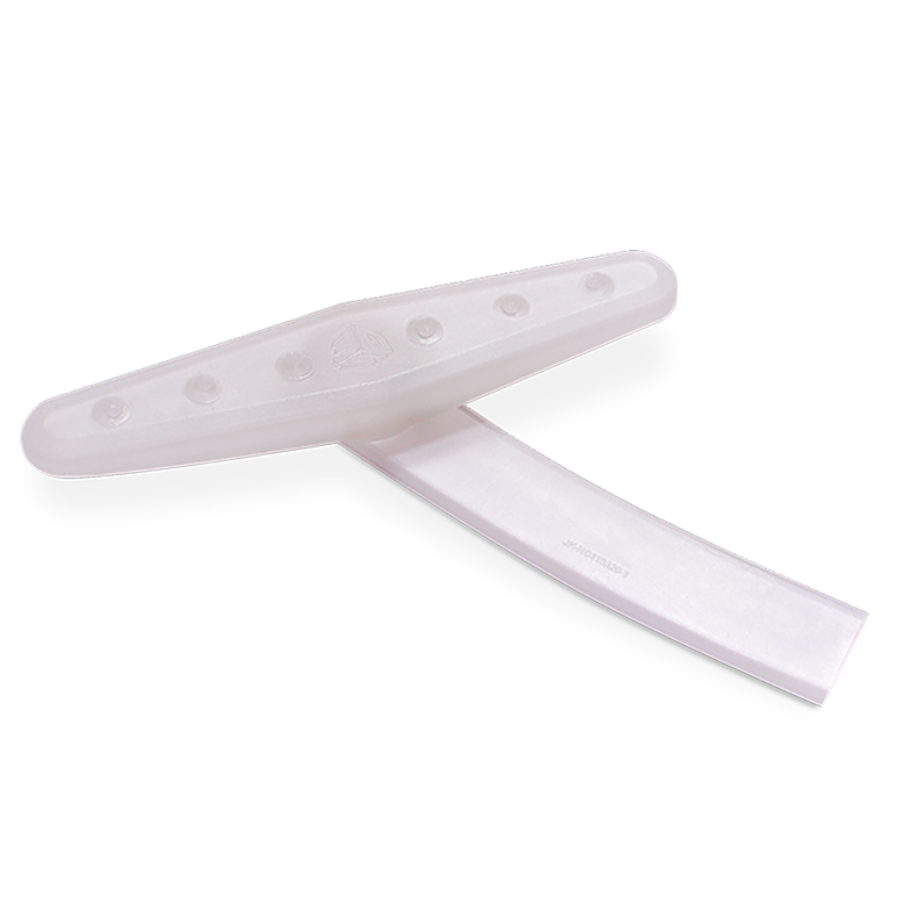
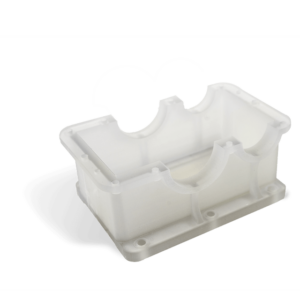
The translucent amber appearance of VisiJet M2S-HT250 (MJP) improves visibility of internal geometries during inspection. In addition, internal channels, wall thickness transitions, and enclosed features remain accessible for visual verification without destructive testing. As a result, the high temperature MJP material supports development of fluid handling components, thermal housings, and electronics enclosures where internal geometry directly affects performance. Surface quality also remains uniform across builds, enabling accurate measurement and inspection with minimal post-processing. This controlled print behavior supports faster design validation in heat-critical applications.
Heat Resistant 3D Printing Resin with Mechanical Stability
VisiJet M2S-HT250 combines thermal resistance with mechanical stability to support structurally loaded prototypes and tooling. For example, it features tensile strength up to 57 MPa and a flexural modulus of approximately 3600 MPa. These capabilities allow printed parts to withstand mechanical stress during functional testing. In addition, low elongation limits deformation and helps components maintain geometry when they’re exposed to combined thermal and mechanical loads.
This heat resistant 3D printing resin is well suited for tooling, fixtures, molds, and structural housings that experience sustained heat exposure. Predictable performance across builds helps engineering teams validate designs with confidence while minimizing risk during thermal testing and qualification workflows.
Thermal Performance Engineering Photopolymer for Production-Oriented Workflows
VisiJet M2S-HT250 (MJP) maintains mechanical and dimensional stability through repeated heating and cooling cycles. In addition, its resistance to thermal distortion supports extended use in industrial environments and the smooth surface finish and consistent print behavior reduce secondary finishing while preserving feature definition. These characteristics make the material suitable for production-oriented MultiJet Printing workflows that require documented thermal performance, dimensional control, and repeatable output.