Flexible TPU 3D Material for Production-Ready Components
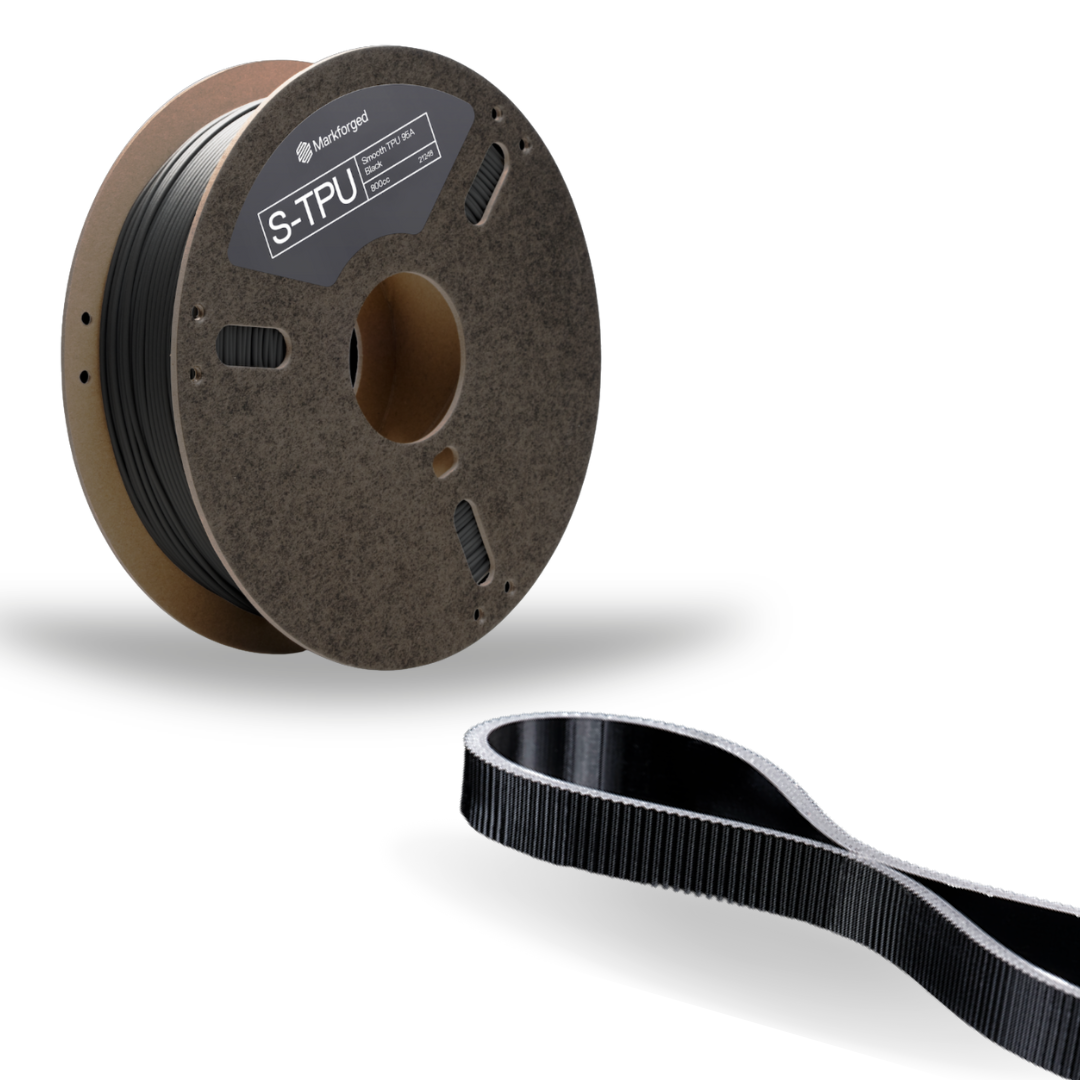
Smooth TPU 95A combines elasticity, durability, and controlled deformation to support demanding manufacturing environments. With a Shore A hardness of 95, it delivers predictable mechanical response under load while maintaining structural stability. In addition, its tensile strength of 26 MPa and 550% elongation at break allow the material to stretch, flex, and rebound without material fatigue. These properties make it suitable for seals, shock-absorbing elements, grips, and precision fit components where rigid thermoplastics cannot perform. Because the material maintains performance across a wide temperature range, engineers can deploy TPU 95A in applications exposed to vibration, repeated deflection, or intermittent mechanical impact.
Elastomeric 3D Printing Tuned for Reliability
Markforged designed Smooth TPU 95A for stable, repeatable elastomeric 3D printing. Its extrusion characteristics support smooth deposition, strong layer bonding, and high dimensional accuracy—common challenges with flexible materials. The filament runs on the Mark Two™, X7™, and Onyx Pro™ , integrating directly into established Markforged workflows. These systems ensure reliable output for both prototyping and low-volume production. in addition, the matte surface finish reduces post-processing and supports efficient inspection. Available in black and white, TPU 95A also simplifies part identification during validation and assembly processes.
Rubber-Like Additive Manufacturing for Industrial Use Cases
Smooth TPU 95A is engineered for impact-resistant 3D parts that must withstand continuous loading, compression, or shock. In addition, its resistance to oils and common shop chemicals allow it to function near machinery or in production areas with variable environmental conditions.
Applications include bumpers, bushings, vibration-isolation elements, wearable components, and custom-fit fixtures. The material’s ability to deform under stress and recover its original shape gives teams flexibility during design iteration and accelerates prototyping cycles. This performance makes TPU 95A a dependable tool for elastomeric and rubber-like part production within modern additive workflows.