Industrial Stainless Steel Printing for High-Performance Applications
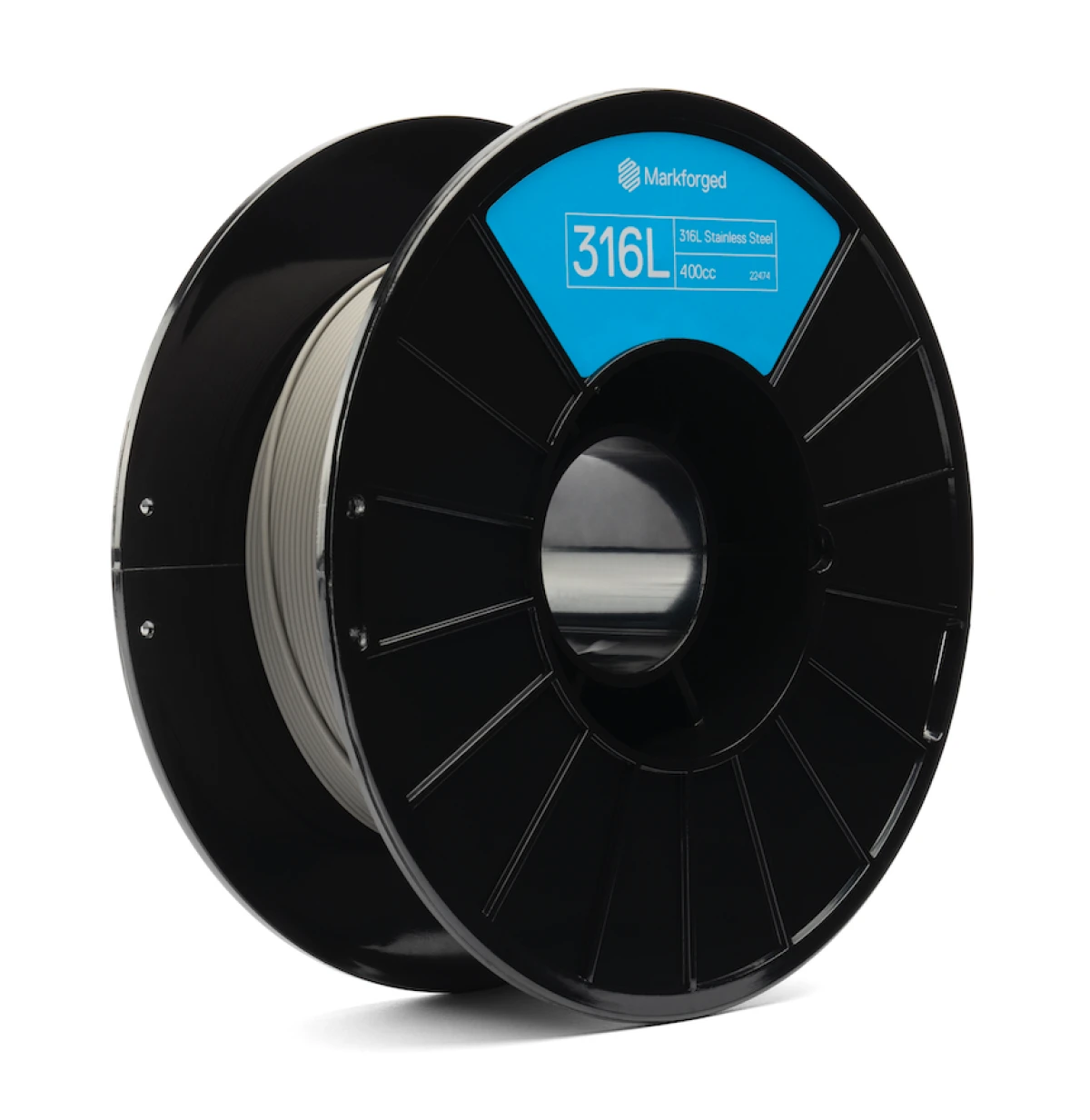
Markforged engineers designed the 316L low-carbon stainless steel to be corrosion resistant, strong, and tough. This makes it suitable for food and beverage processing, automotive systems, chemical and petrochemical equipment, medical devices, and marine environments. As a high-strength metal filament, Markforged 316L supports industrial stainless steel printing for applications that demand durability and cleanliness. In addition, the FX10’s controlled thermal environment enables 316L to produce dimensionally stable parts for daily production and harsh operating conditions.
Heat Resistant 3D Printing with Marine-Grade Stainless Steel
The 316L marine-grade alloy withstands saltwater, acids, and chemical exposure better than standard stainless steels. This makes it well suited for heat resistant 3D printing in environments where metals face thermal cycling, moisture, or corrosive agents. Its low carbon content limits carbide formation during welding, preserving joint strength and corrosion protection. Engineers rely on 316L for valves, tanks, offshore hardware, and pressure components that must maintain integrity under demanding conditions.
Durable Steel Additive Parts for Production Use
Markforged 316L stainless steel produces dense, fully sintered components that function as durable steel additive parts without extensive post-processing. In addition, the material’s clean surface finish and dimensional stability support end-use applications such as industrial jigs, fixtures, structural brackets, and end-of-arm tooling. As a high-strength metal filament, it enables manufacturers to print metal parts on demand while maintaining corrosion resistance and mechanical performance. In addition, the FX10’s process architecture allows 316L stainless steel to generate strong, repeatable components suitable for continuous production.